Do not be careless… care less.
When annoyed, we cannot bring our heads to the doctor, drop them off, and pick them up the next day. Long exhalations from our lungs can relax our minds.
When scared, we cannot momentarily and safely remove our amygdalas, the parts of our brain in charge of fear, and replace them once threats pass. Connecting with loved ones can calm our nervous systems.
When physically injured, we cannot convince ourselves we are, in that moment, fully healthy by simply talking it through with someone else. Rest is best when it comes to healing our minds, our bodies, and our spirits.
What we focus on determines how we feel. How we feel shows up in our bodily sensations. Sensations signal for us to move, stay still, talk or just breathe.
“Thoughts are the language of the mind. Feelings are the language of the body. Emotions are the language of the spirit.”
As a professional athlete and a mental coach, I believe in the integrative approach for health, wellness, and peak performance.
Mind-Body-Spirt… they remain connected as one.
That’s why, as a professional athlete and a mental coach, I believe in the integrative approach for health, wellness, and peak performance.
—
It was one of my first scrimmages at Yale University as a varsity lacrosse player. I ran onto the field with high hopes and an extreme intensity. The problem was, I was also tense. The goalkeeper threw me an outlet pass. I went to catch it, and as if I had a tennis racket in hand, it bounced in-and-out of my lacrosse stick’s mesh, seemingly all the way back to him.
This is a common illustration of performance anxiety. It wasn’t that I didn’t care. It was that I cared too much.
Anxiety is a bias toward action.
Depression is a bias toward rest.
Too much rest or too much action is pernicious to performance, health, and longevity.
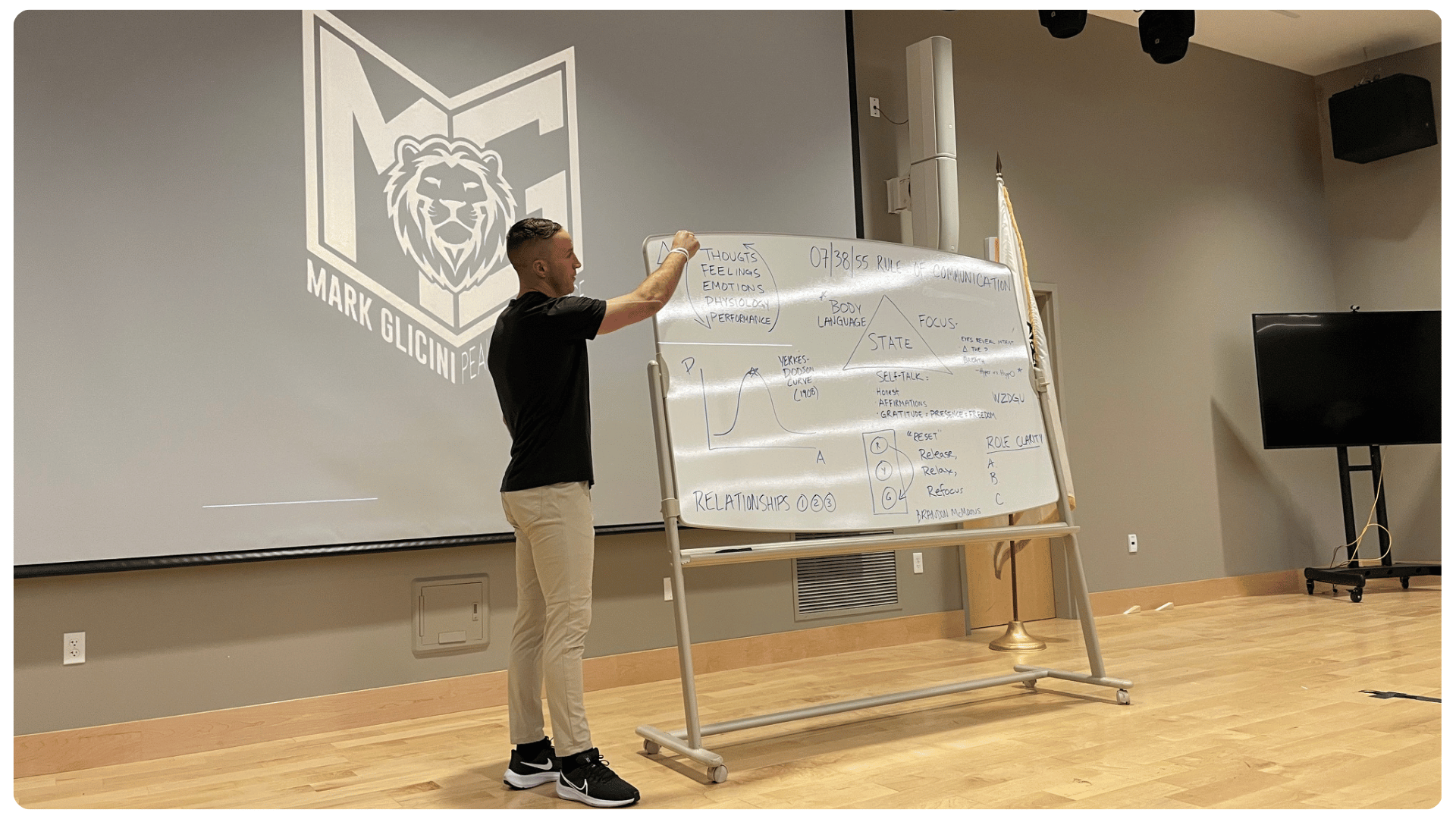
The Yerkes-Dodson Curve presents a simple graph of an inverted-U, clearly displaying the relationship between performance and care. Care equates to arousal and stress levels. When we care too little, we become bored and indifferent. When we care too much, we become exhausted and full of panic. The optimal zone, where learning and growth happens, requires us to attend to what we doing an appropriate and adequate amount.
Stress is a neutral term. Eustress points to its positive aspects, when it provides enhanced focus, motivation, and energy. Distress includes its negative impacts when it lasts for a long time, pulling us apart in a distracting and tense manner. Our preparation of expecting undesirable circumstances, which involves protocols for adaptive performance, allow us to adjust on the fly rather than doubt, hesitate, or falter under pressure.
We improve our physical flexibility by stretching our ranges of motion; we improve our mental resiliency by expanding possible pathways forward through eustress and continuous curiosity.
Let’s incorporate more activities, people, hobbies, endeavors, and experiences that bring us more eustress and less distress!
It was one of my first speaking engagements. I was doing it alongside my mentor for a graduating high school class of 186 students. Leading up to it, my mentor refused to let me know what we would be speaking about. I asked him a couple days before. I asked him, again, in the parking lot before we entered the school. I asked him right before we went on stage. He did not tell me.
And then it began.
He interacted with the students, asked them questions, and provided them with tremendous insights on how to take on life in college. In the middle of his presentation, he turned to me and said, “Now, Mark will speak to you all about what it takes to be great at the next level.” I looked at him, then I looked at the audience, and then I my mind went blank. Sweat poured through my shirt. I mumble through words… and many times, as I was attempting to connect different ideas, I forgot the points I wanted to make. There it was, once again, performance anxiety.
After it was all over, I conversed with my mentor outside of the school.
He said to me, “Excellent job, Mark, you were great! I loved your energy. You will only continue to get better from here on out.”
“Great?” I responded, “That was terrible! What’s the reason you did that… not tell me what would we be speaking about and then throw me into the fire? I was so frustrated because it seemed like many of the students were not paying attention. They were either flirting with each other, using their phones or completely disinterested.”
“Transformation requires full immersion, Mark. You’re not there for 186 students. You are there for one student on the edge of his or her seat, with bulging eyes, who cannot wait to hear what you have to say next.”
That is a line I never forgot. It’s a line I will never forget. It’s a line I repeat to myself over and over to this day: we are here to inspire one person at a time.
He was right.
Many people won’t care what we have to say.
So, why do we care so much… and is it more important for us to be happy or to be liked?
“The meaning you give to your life is something you decide for yourself…
You are not living to meet someone else’s expectations…
You are not your past…
Your life is decided by what you choose to do now…
The courage to be happy also includes the courage to be disliked because no one can make you feel inferior without your consent.”
— The Courage to be Disliked
It’s not about being careless.
It’s about embodying what it means to care less.
Care less about the outcome; immerse into the process.
To trust this process means to focus, concentrate on, and cherish the next task we could be great at.
• We ought to immerse ourselves into the mental training strategies that optimize our peace, the physical exercises that optimize our durability, and the spiritual disciples that optimize our enthusiasm—(after all, the derivation of “enthusiasm” is “en theos,” which means the spirit of “God within”)—it’s possible to take care of our minds, bodies, and spirits without imprisoning ourselves with the chains of worry, neediness, and insecurity.
• We ought to love those who love us, to live authentically, and to laugh at inevitable inconveniences.
• More than anything else, we ought to prioritize who we are becoming, imitating, and loving.
Who are we becoming holistically?
Who are we imitating intentionally?
Who are we loving carefully?
In your relationships with one another, have the same mindset as Christ Jesus.
— Philippians 2:5
 Mark Glicini
 Mark Glicini: Oct 8, 2026, 7:03:00 PM
.png)
.png)